
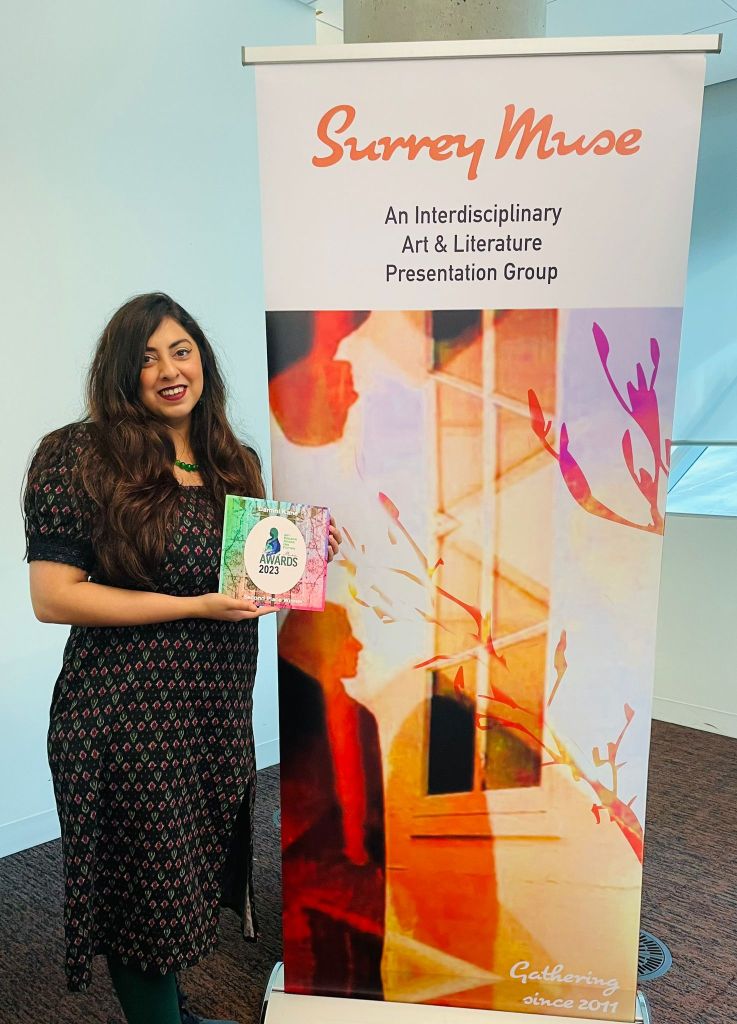
Recently, my speculative fiction short story, Words Like Frost, won second place in the Joy Kogawa Award for Fiction organised by Surrey Muse. It was such an honour to receive the prize and interact with an incredible group of writers and artists at the awards ceremony held last weekend.
Words Like Frost was inspired by thoughts of language and how languages die.
You can read the story right here!
Words Like Frost
We saw him building his house one morning, and the next day it was done. He did not have a fence, so the berry bushes trespassed onto his grasses, their thorns and poisons welcome guests. We did not know how old he was. Staring into his face was like staring at a mountain; at once we were aware of his magnificence and permanence. He strode over to our side of the fence with a vessel in hand.
He stood over us and smiled, and we stared up. Juni, beside me, was entranced. I kept thinking I knew him from somewhere, though I had never left the confines of this plot. I thought maybe he looked like my grandfather, whom I had never met, but had heard stories about. Worse, I thought he looked like my brother, who died in a foreign land, fighting someone else’s war.
I did not understand his language, but we were hungry, and the vessel he held steamed with broth, so we let him through. I think we would have let him in even if he was empty-handed.
Our home was more about what it was not. It was not large. It was not warm. It was not comfortable. It did not have two rooms. It did not have a kitchen. It did not have a stocked pantry. It was four creaking walls holding their own against old trees and a forest full of hidden monsters. Looking back, I think I was too young to understand. I am made of what I lost. I see now that Juni and I were losing him even as we found him.
He went straight to Ommutta. She was lying curled, the threadbare sheet up to her throat. Chickens and fish have bones but I’d never seen human bones until they started sticking to the ends of Ommutta’s fraying skin. Privately Juni and I agreed Ommutta was less human and more object, for all she did was lie down and struggle to breathe. She would eat little, and soil herself, and babble in words we had never heard before. Her white hair was more like dust. Juni often talked about what would happen once she died. How would we feed ourselves? As if we depended on her for that anymore.
Ommutta was our grandmother. We loved her, but like all love, it was being replaced by apathy. I am starting to wonder if we love things more when they’re already dead. It’s hard to care very much if they spend too long dying.
The stranger with the face like time set the vessel down on our table. He looked around for utensils, and when he found a bowl, one my brother had carved from an old tree, he picked it and stroked it with a thumb. Absently, like wiping a tear. Then he poured the broth and went over to Ommutta’s bed.
He spoke in tongues. His hand stroked her wrinkled forehead, as he coaxed words from her. She responded on the third try, rambling in a language neither of us had heard. He led her in a sitting position, supporting her birdlike weight with one strong arm, and held the bowl so she could drink. He was speaking continually. I think he liked the sound of his voice. His tones were bright but translucent, his language made of hushed sounds in strange and dreamlike shapes. His words snowflaked off his lips, turned to water in our ears, and evaporated across the stuffy room.
Ommutta responded.
“What language is she speaking?” Juni asked. I shrugged. I didn’t know where Ommutta had come from, just that she had always been here, in this little barricaded house in the woods, afraid of the outdoors and yet surrounded by it. Our lives were a bead missing from a necklace, isolated.
Though we didn’t know his words, we knew the man was coaxing her to eat. When the bowl was empty, he laid her back down and pulled the covers over her. His fingers lingered on the fabric. He turned to us and made a noise. I don’t remember the sound anymore. It was a word, and from context, I learnt it meant ‘wait’. As with all things, I have lost it now.
He left, and we waited. Juni washed the bowl. I stood over Ommutta, curled in on herself, asleep already. When the man returned, he was carrying a roll of wool, thick as a fat sheep. It was the largest blanket I’d ever seen—big enough for Ommutta, Juni, and I, if we lay together. He draped it over her small body, and I watched the tightness in Ommutta’s face give way to a comfortable sigh.
Then he turned to us. He spoke again. I did not understand his language, but he gestured to us and pointed at the vessel. He said a word then, something with an h-sound, I think, and Juni said, “Oh!”
She found more bowls—these days, we had more utensils than food or diners—and set the table for three. The broth was hearty, with meat, potatoes, and salt. It had a dirt-like crunch to it, and burned my tongue. I had only heard of this thing–it was called pepper. It did not grow in these parts.
“How do you know Ommutta?” I asked.
He said strange words.
“I can’t understand you. Don’t you speak my language?”
He tilted his head, regarding me with a brow raised. We did not speak alike, but his expressive face communicated amusement and scepticism, and, I thought, layers of bone-deep disappointment.
“How—do—you—know–Ommutta—?” Juni demanded, saying each word slower, as if that would make any difference.
He glanced at Ommutta, asleep under a blanket thicker than her. He set his bowl down and gestured with his hands once more, bringing them together, and pulling them apart. He did this three times before we caught on.
“You…you knew her when she was young?” Juni guessed, frowning. “Just how old are you? You don’t look that old. How—old—are—you—?”
He squinted, and at first I thought he was angry, but then I saw the twist of his lips, the frown, and figured he was thinking. It was not that he did not understand us, I realised with a jolt. We did not understand him. If he could comprehend our questions, could he not respond in kind?
“How—old—are—” Juni repeated.
“Don’t bother him,” I said. “He is thinking.”
She scowled, but fell silent.
Our guest glanced around our small house, our nought-space. His eyes landed on the bowl again, the one my brother had carved. He left the table to retrieve it, and placed it rim down. His finger traced the lines in the wood.
“Yes, it’s from a tree,” I said. “A tree that used to grow on this property.”
“It fell a few years ago,” Juni added. “It was very old.”
I stared at my sister. “Are you saying, sir, that you are as old as this tree?”
What good, I thought, was a beautiful word, if one could not understand it? I stared at his mouth, filled with words like a chasm. He didn’t look at either of us. His finger simply traced the bowl, over and over, as though counting its rings.
“No,” I mused. “You are older than this tree.”
He glanced up, his mouth quirking into a smile.
“That begs the question, how old was the damn tree?” Juni mused aloud, and I couldn’t help but smile.
Our guest let out a long, frustrated sigh. He stood, gesturing for us to follow, and took us to the yard. Our yard did not have poison berries, not like his, but it was smaller, and emptier. He crouched and dug his fingers into the earth.
“What’s he digging for?” Juni asked me.
“Perhaps,” I wondered, “you are as old as the land.”
His shoulders slumped. He did not look at me, but I saw him nod.
I think back to that moment a lot. I did not understand him, then. The land we lived on was not ours, nor was it very old. But the tree in our yard, the tree that had died, the tree that became a bowl at my dead brother’s hands, was not from this land. It came from far away, smuggled for its fruit, smuggled for its sacredness. He was older than the place we lived. He had tied his soul to foreign trees.
He stood and dusted his palms. Grime coated his nail beds. He looked back at us and I thought I saw a shimmer in his eyes, like he was fighting back tears. In that moment he looked thinner, and sicker, his bones sticking to his skin like Ommutta’s, both of them hovering on death’s threshold.
I blinked, and at once it was gone, that sense of endness and mortality. He was as he had been before, magnificent and beyond time, a creature older than anything we could imagine. He put a hand over his heart. “Sonvinya,” he said, and I think he was introducing himself.
“Is that your name?” Juni demanded. She told him ours.
Sonvinya walked home, and returned with a fat book. Bound by vellum, it was in a language we didn’t know, and had illustrations of creatures I assumed to be fairies, witches and monstrous beasts. It was a book of stories for children. He sat by Ommutta’s bed, stroking her wispy hair. She was stirring again, babbling uncomfortably in words we had no access to.
Sonvinya gestured for us to approach her. Juni crawled into the bed, pulling the soft duvet up to her throat. I sat atop the covers, my knees to my chin. Sonvinya cracked open the book and began to read aloud.
When we were younger and Ommutta was more alive, she used to tell us stories. She told us about our grandfather and our father and our brother, how they went off to a foreign field with their swords and never came back. She told us about the place she was born, its old trees and pepper plants and warmth, and how she milked cows and how she ran for her life. I used to think we knew a lot about her, but in hindsight, we knew nothing. I don’t know what happened to her people, except that it was violent and total. I don’t know what language she spoke, how she used to dress, or what her dreams were. The world we grew up in was secretive, a little plot in a deep forest, fenced and fearful.
I am not that girl anymore. I don’t remember myself well enough to be.
Listening to Sonvinya’s odd language, his whispered story like a tumble of vines, his words that sounded like minutes slipping away, I realised that I knew nothing at all; had never known anything of consequence. He turned the book around so we could see pictures. He pointed to the inked form of a young princess. He said a word.
I don’t remember that word. I know it meant ‘girl’, because he told us so. He pointed to us both, and said a sentence, and I knew he was explaining himself.I knew it! But I wish I could remember what he’d said. His words are gone. His language is gone. I don’t remember anything.
Ommutta died that night. It was a quiet thing, mid-narrative, as Sonvinya turned a page. We watched him read, and watched him stop, his eyes resting on her body. We heard it, her last breath, and I thought of the final leaf from our dead tree, falling in the backyard without anyone noticing. I thought of my brother, who must have gone out there to examine the rotten old wood, looking for something to salvage. They were all gone now: the tree and my brother and Ommutta, their country, their pepper and their language.
Sonvinya shut his book.
“Ommutta?” Juni asked, shaking her shoulder. “Ommutta, wake up. Wake up, the story isn’t over.”
He placed a hand on her forehead, as if checking for a fever. His fingers trailed lower, down the concave of her sunken cheek, to her shrivelled lips. His thumb pressed around her mouth, like a lover’s, but his eyes just looked sad. Like he’d lost someone.
Sonvinya gave me the book. He stepped out again, and returned from the yard with a couple of large shovels. We would have to bury her.
Juni was crying, holding Ommutta’s body. I went to help. Wordless, for once, he tossed me a shovel and we dug in silence.
“Are you grieving too?” I asked him, sweat-soaked, bathed in mud.
He said nothing. Silent tears were falling from his face as he worked.
“Aren’t you going to talk? You’ve been talkative thus far.”
He shook his head. He put a hand on his throat, leaving soil marks where he touched his skin. I lowered the shovel, my arms burning. “You…you can’t speak, can you?”
Mortality was showing on his face again. I had thought he was mountainous and majestic, but he was a mountain on the verge of being washed away, eaten and eaten by an unrelenting sea of time, until there was nothing there but crumbs at the shore. He did not meet my eye, his white hair falling over his brow. He stared at the pit. It was too big. He could easily have fit inside with her.
“You died when she died,” I said.
He threw the shovel on the ground and turned away, traipsing back inside. He returned quickly, Ommutta’s fragile body in his hands, looking like a bramble of broken branches. Juni trailed after him, red-eyed, wiping her nose with the back of her hand. Sonvinya lowered the body into the grave. I almost wondered if he might lay there with her, and allow us to bury him. But he climbed out. He and I began the slow, bitter task of replacing the mud. I did not know if it was day or night, or if the passage of hours even mattered anymore. The light was sickly, pale and blue, like a corpse.
Ommutta was buried, and we stood around her grave.
“I want to say a few words,” Juni declared, wiping her nose again. “Ommutta, I love you. And I’m going to miss you. ”
She looked at me, and I swallowed. I don’t know why I couldn’t muster tears. I think I was just very tired. “Ommutta, you lived a long and complicated life. I wish we’d had the chance to know you better. I will always remember you.”
“Do you want to say anything, Sonvinya?” Juni demanded.
“He can’t speak.”
Sonvinya knelt over the grave and placed a hand in the mud. He patted it, straightened, and then walked away. Past us and our little house, beyond our fence, straight into his open property, into his little hut. Juni shrugged, and I tugged her back. We retreated to our own home, where I washed myself the best I could with a pail of water. The vessel with broth was still there, as was the thick duvet, the storybook, and Sonvinya’s muddy footprints.
We huddled in bed, promising each other we were too sad to sleep, and yet drifted off anyway, worn-out and warm. When we awoke, Ommutta was still dead, and the morning was bright. Juni curled on her side, weeping, but I stepped outside, my limbs sore but aching for activity.
This time I went past our fence. I crossed over to Sonvinya’s house. Maybe we could eat together again. Maybe he could teach us how to cook his strange food; Ommutta’s food. But his door was ajar, and his home was empty. It did not have much: just a few pots and pans and a bed. But he had many books, in a language I could not read.
“Sonvinya?” I called, glancing around. He was not there, of course. He told me so yesterday. He died when she died.
I picked up a book, its strange script, its inky illustrations. It was too late now to learn what the words meant.

 Damini Kane
I remember this. Superb.
LikeLike
Thanks!
LikeLike