

I’m almost embarrassed to be writing this post. But I spent all weekend watching Face Off: Inside the NHL, a docuseries about the 2023-2024 NHL season. In the last couple of years, I’ve become a hockey fan, and like all things I get into, it’s become an obsession. I spend an excessive amount of time looking up teams and players. I’ve read multiple hockey memoirs, I’ve seen an NHL game in person, I have a favourite team, and favourite players. But. This isn’t about all that.
This particular post is about a hockey player named Matthew Tkachuk, alternate Captain of the Florida Panthers, the team that won the coveted Stanley Cup last year. If you’re new to hockey, let me just say this: the Stanely Cup is considered the hardest trophy to win in sports, and the team they won against, the Edmonton Oilers, is captained by Connor McDavid—considered the best hockey player in the world, possibly of all time.
I don’t like either team. I don’t like McDavid and the Oilers on principle. They kicked my team (the Canucks) out of Stanley Cup contention last year. But I can tolerate them far more than the Panthers, mostly because I hate Matthew Tkachuk. I’m also aware that me saying this might make him happy. Tkachuk likes to be hated. He’s a dirty player. In fact, the Face Off docuseries is a revealing insight into the fact that, actually, he might be a bit of an A-hole.
But I’m not going to talk about why I hate him. Because the things that make him so easy to hate are also some of the most interesting things about him. And while I don’t agree with anything he’s said in the docuseries, I think there’s something incredibly compelling about his whole shtick. And there’s something to learn from it, in terms of creating a resilient mentality. A mentality that one desperately needs to have a career in the arts.
So, I’m going to grit my teeth and do two cringeworthy things at once: I’m going to write an actual ‘how to have a winning attitude’ blog post (yikes), and worse, I’m going to say something nice about Matthew Tkachuk.

One of the most interesting moments in Face Off, for me, was in the first few minutes of the final episode, when Pete Blackburn, one of the people interviewed for the documentary, says, “All this talk about Connor McDavid and how good he is, and how he’s the best player on the planet…I don’t think Matthew Tkachuk gives a damn.” (Face Off: Inside the NHL, S1E6)
Think about the best person in your field. The greatest. The most excellent performer. The elite of the elite. That’s who Connor McDavid is to hockey. I cannot emphasise how much of a big deal this guy is. People call him McJesus.
So when I heard Blackburn say that about Tkachuk, it felt like a light bulb went off in my head. Was that always an option? To just not give a damn?
The docuseries also presented these two players in radically different ways. They both wanted to win, both for different reasons. Matthew Tkachuk wanted to win for his father, also a pro hockey player who never got to win the cup. Connor McDavid wanted to win because he had been raised to believe the cup was his destiny. McDavid is portrayed as a genius burdened with the hopes of millions. He looks almost haunted by his ambition in practically every frame. He has a quiet demeanour and stares soulfully into the camera, and there’s an air of…almost tragedy in his face. McJesus on the McCross.

Tkachuk, on the other hand? Well, in one of the first shots we see of him, he tells the interviewers that when he moved to Florida, his second purchase, after his house, was his golf cart. A golf cart that he then proceeds to drive around town like it’s an SUV—but oh, not before wearing his “golf cart (sun)glasses”. He has “golf cart glasses, casual glasses, pool glasses, jet ski glasses, nothing glasses,” and adds, “simple life down here.” (Face Off: Inside the NHL, S1E3)
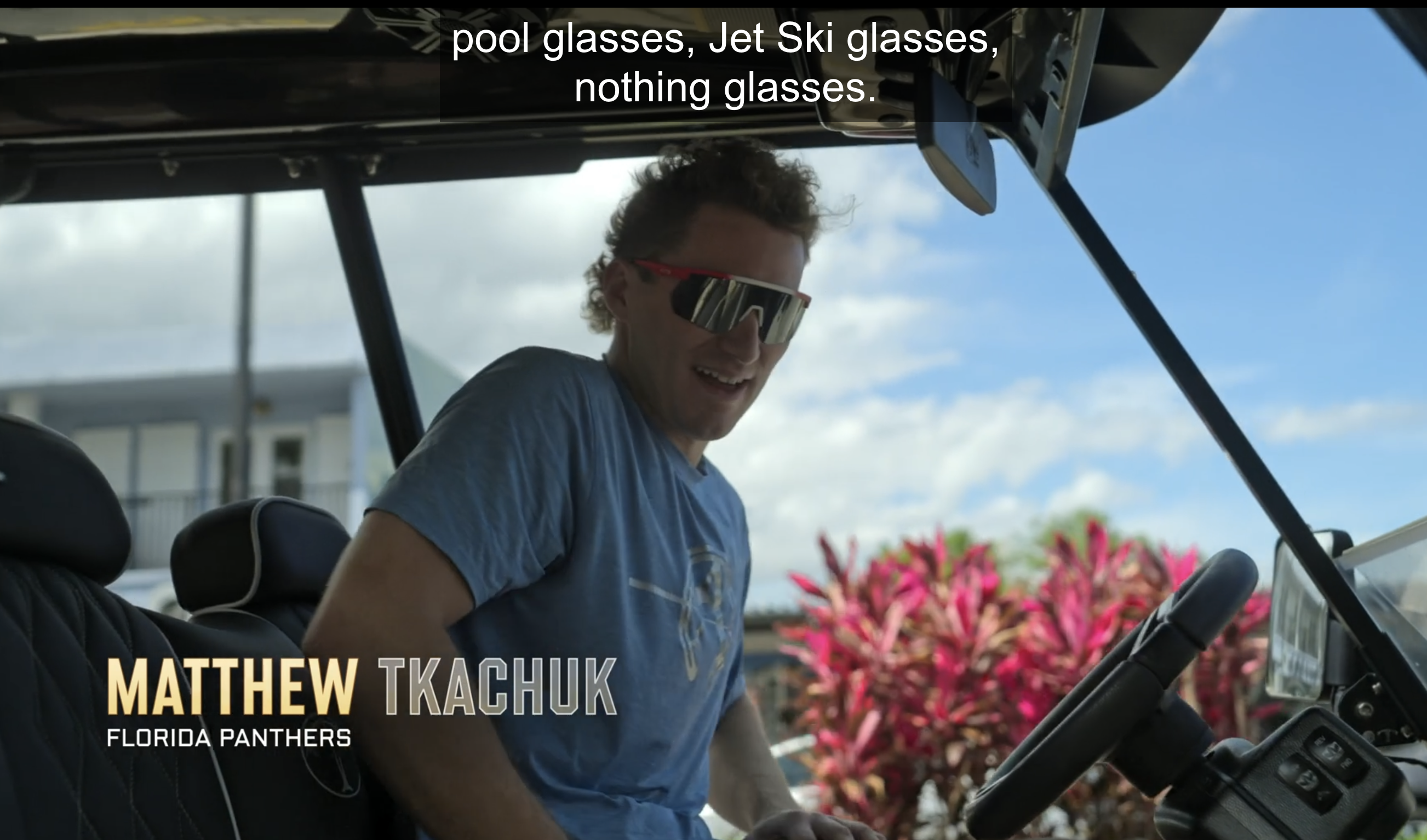
In the lead-up to the finals, audiences get a glimpse of Tkachuk lounging by the pool, saying he’s “super relaxed and weirdly too relaxed”. (Face Off: Inside the NHL, S1E5)
You also see Tkachuk goofing off with his brother, Brady (another NHL-er and player I hate!), and his father. You don’t get as many lighthearted scenes with Connor McDavid. The man looks miserable in his high-performance McMansion (that’s a pun for hockey fans and architecture nerds) with its indoor hockey room and private gym. I’m sure that a part of me is also making assumptions. I don’t know these people. I could be wrong. But judging from the docuseries alone, it just seems to me that Matthew Tkachuk is just having a far better time.
I’m fascinated by this guy. I hate myself for it. But his approach to pressure is so contrary to everything I know about it. I cannot stand the way he acts, on the ice and—if you can judge just from the documentary—off it. I doubt I’d be able to carry a two-second interaction with him in person. But there’s something to his effortless, screw-you swagger that’s worth learning from.
See, I think the problem is that when you expect yourself to succeed to the point where it’s your whole identity, it’s very, very hard to have fun. The stakes just become so astronomically high. That’s not to say that Tkachuk didn’t want it as much as McDavid. I’m not really one to comment on that. How do I know? But I did get the impression that McDavid believed his entire life was leading up to that moment, so losses were all the more brutal, and the victories far less sweet. Tkachuk, on the other hand, played aggressively the whole time, had no qualms about getting under the other team’s skin, being a pest—and enjoying every single freakin’ moment of it.
Of all the hockey players interviewed in Face Off’s six-episode season, I don’t think any of them were having as much of a raging blast as Tkachuk was. It certainly didn’t look that way from the outside.
Is that the secret, then? To just not give a damn?
It’s not to say that Tkachuk didn’t put in the hard work. He talks about playing through a fractured sternum in the season prior, and being in so much pain that his brother Brady had to help him out of bed and gear him up. The dedication and guts to do that is not something to sneeze at. I don’t think anybody can reach that level of accomplishment and not work very effing hard. But aside from the hard work, there’s so much to be said about intent. Are you here to win because you have to win? Or are you here to play because it’s fun?
How does this translate to writing?
Well, I can only speak for myself. I put a tremendous amount of pressure on myself to produce. So much so that I often find myself paralysed by the expectation of doing too many projects. I also hold myself to a very high standard of quality, which means I second-guess everything I do. This has actually gotten worse since I did my MFA, because my degree forced me out of my comfort zone and made me explore new ways of creating stories. Naturally, I want to create stories in every possible genre, and have them all be perfect. I want a big life. I have very big dreams.
Lately, I’ve not been enjoying writing much, you know.
It used to be the highlight of my day. I’d get off work and then spend a couple of hours working on a novel or short story. I’d wake up at 4 am, sometimes, and bang out a cool 1000 words before getting ready for class or the office. Yes, it came with a sense of accomplishment, but also, I was having so much fun.
One piece of advice I’ve received in the last year is: You can’t control the outcome. You can only control the work you put in.
I’d like to add another dimension to that now.
You can’t control the outcome. You can only control the work you put in. And you can only really keep putting in the work if you allow yourself to enjoy it.
Get out of your head. Take off that mantle of expectation. Undo the screws that wind you so tight and let the pressure escape. Kick back and be too relaxed, weirdly relaxed, and that might be just the thing you need to get you what you want.

 Damini Kane