

I do this thing where I use a lot of metaphors. And imagery. And similes. Even when they’re unnecessary. Seriously, I do this all the time. I put the words “like a” into the search bar in one of my old manuscripts and came up with:
- She was like a hummingbird, delicate and decisive.
- He was studying her like a statistic.
- He swished down the corridor like a winter wind.
- It had been like a volcanic eruption, shocking and violent and ugly.
- … her thick blonde curls falling over her face like a mane.
These are just 5 of 87! At some point, it had become automatic, a habit I couldn’t break. When I wanted to describe something, I resorted to imagery immediately, without even trying something else. And I know why. Writing like this is effortless. It gives you the impression of information without actually conveying anything.

In my head, I knew exactly what I wanted to describe, but when it came time to put the words on paper, I took the easy way out. “He was studying her like a statistic.” That tells you something, or at least, it wants to tell you something. I want to say that he was studying her thoughtfully, trying to parse information from her stance so that he could make a decision—he was studying her to use her, somehow. And “her blonde curls falling over her face like a mane” is just unnecessary. I know I can write cleaner than this.
I think this instinct comes from my own preconceived ideas that writing needs to be pretty. That good writing is poetic, and good poetry is full of clever images.

I saw this image floating around the interwebs a long time ago, and it made me mad. I know that poetry is more than “things are like other things”, but in my attempts to develop a more pretty writing style, I resorted to the same stupid philosophy.
This is also a problem I see often with more inexperienced writers. I think we all tend to go through this phase of “my work needs to be beautiful and quotable”, and in our efforts to accomplish this, we often sacrifice clarity. I have, for reasons I can’t get into, been reading a tonne of writing from inexperienced writers lately, and a lot of it makes me go, “Huh?”
Because the writing is so beautiful and pretty and ornamental that I don’t actually understand what the heck is going on in the scene! We tend to call this writing style “purple prose” but I want to use another term (because “purple prose” is kind of loaded). I’ll call it Maximalism. Maximalism done wrong.
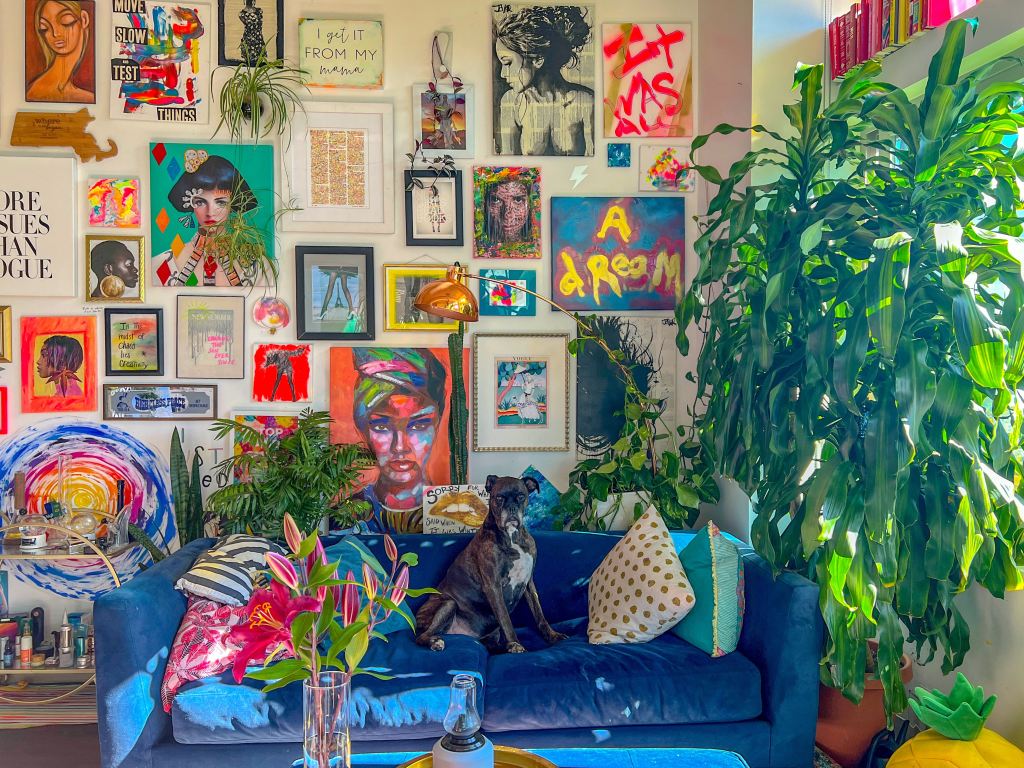
Photo by Steph Wilson on Unsplash
I love maximalism. Fashion, room decor, whathaveyou. Bright colours, patterns, overstimulating details, I am fascinated by it all. I hope my house looks like this someday. How can we bring this same aesthetic into our writing? How can we have a story rich in detail without resorting to the thoughtless use of similies and images that fail to convey any kind of sensory information?
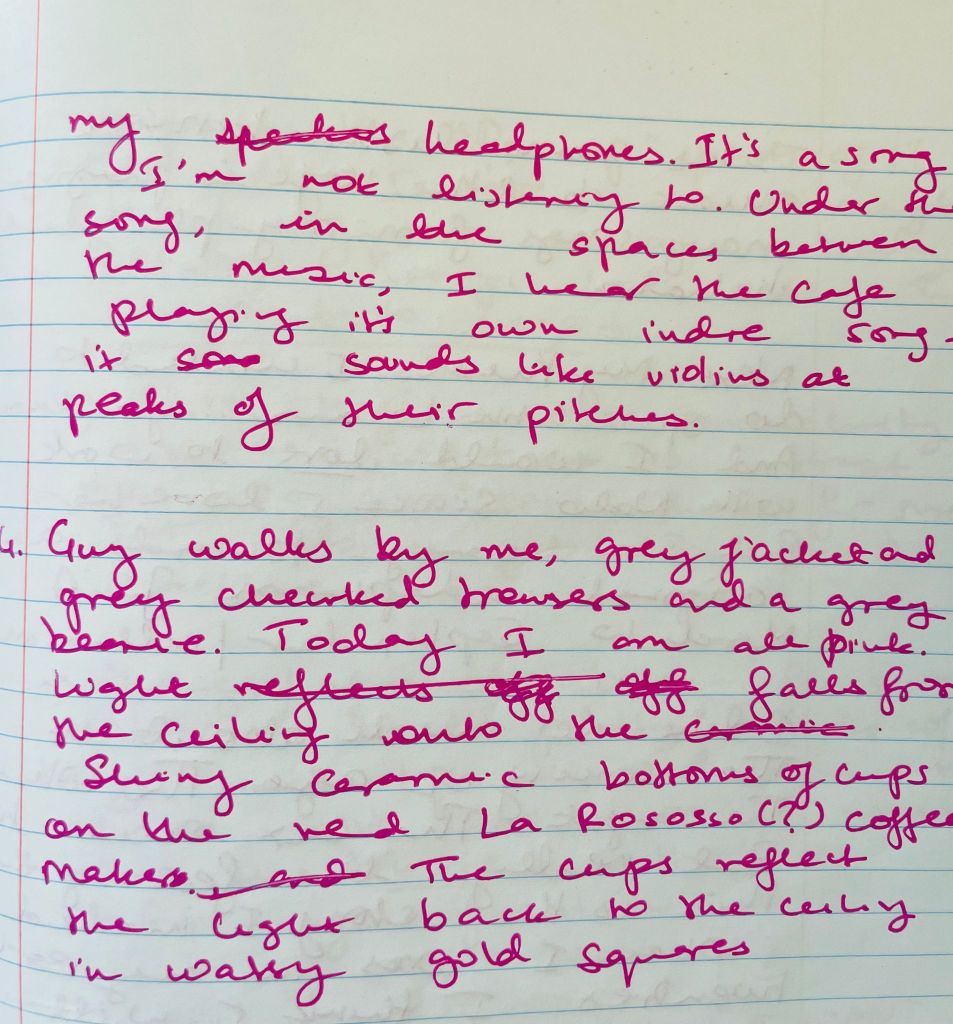
For me, the answer is training. I trained myself to write prettily, and now I need to train myself out of it. So I’ve been sitting in public places (coffee shops and libraries), with a notebook and a pen, and I’ve been writing down the stuff I see and hear (and smell). The catch: I am not allowed to use images. I have to describe things exactly, as clearly as I can. It’s so much harder than I realised.
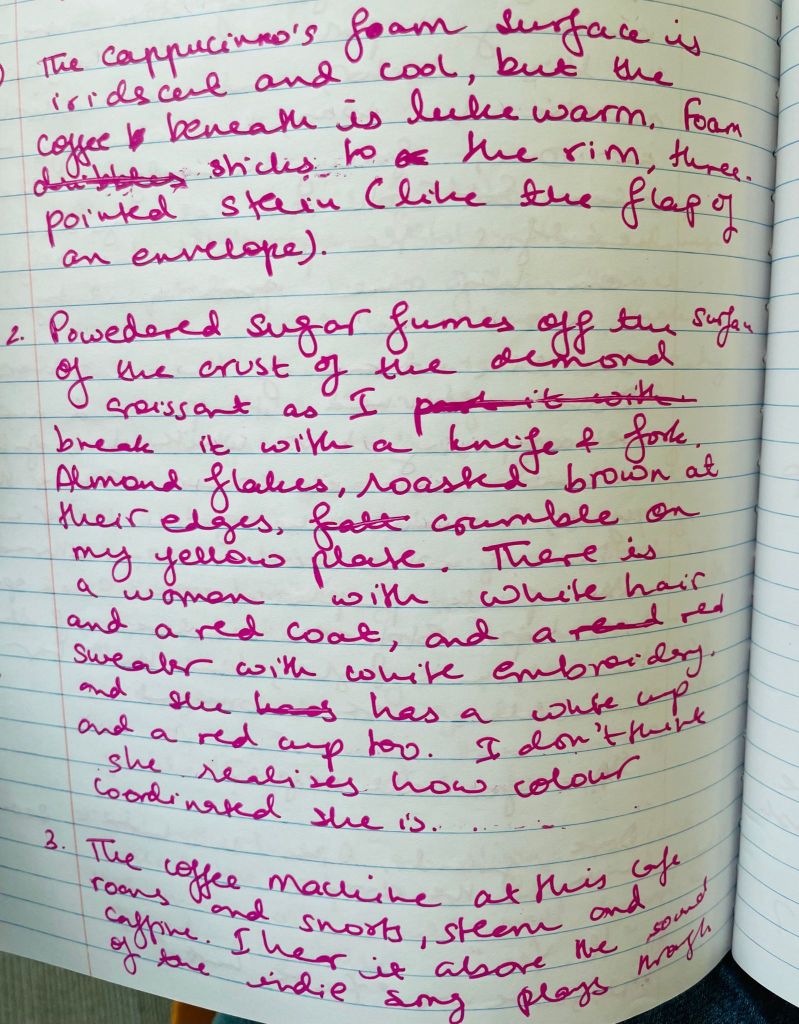
- The cappuccino’s foam surface is iridescent and cool, but the coffee beneath is lukewarm. Foam sticks to the rim, a three-pointed stain (
like the flap of an envelopeoops) - Powdered sugar fumes off the surface of the crust of the almond croissant as I break it with a knife and fork. Almond flakes, roasted brown at their edges, crumble on my yellow plate. There is a woman with white hair and a red coat, and a red sweater with white embroidery, and she has a white cup and a red cup too. I don’t think she realises how colour-coordinated she is.
- The coffee machine at this cafe roars and snorts, steam and caffeine. I hear it above the sound of the indie song playing through my headphones. It’s a song I’m not listening to. Under that song, in the spaces between the music, I hear the cafe playing its own indie song—it sounds like violins at the peaks of their pitches.
- A guy walks by me, grey jacket, grey checkered trousers, and a grey beanie. Today I am all pink. Light falls from the ceiling onto the shiny ceramic bottoms of cups on the red La Rososso coffee maker. The cups reflect the light back to the ceiling in watery gold squares.
I remember fighting for my life just writing this. Look at how many times I scratched out my words! I also committed a lot of repetitions, but I wasn’t thinking too much about that during the exercise. I was really just trying to describe things exactly as I saw them, no fancy images to obfuscate my meaning. Ironically, I think this reads quite pretty. Probably because it’s a lot more clear.
A writer who does this kind of verbal maximalism really well, in my opinion, is Donna Tartt. The Goldfinch is full of long, vivid passages describing New York, in such detail that I found myself feeling nostalgic for the city. (I have never been there).
On another note, I think it’s also an honest way to write. Not that I’m against imagery and simile, done well, but I do think there’s something to be said for calling a spade a spade. When you write ugly you can be more truthful about the world. About the characters that inhabit it. And instead of stained glass, you can hold up a polished, gleaming mirror, and dare your reader to peer in.

 Damini Kane