
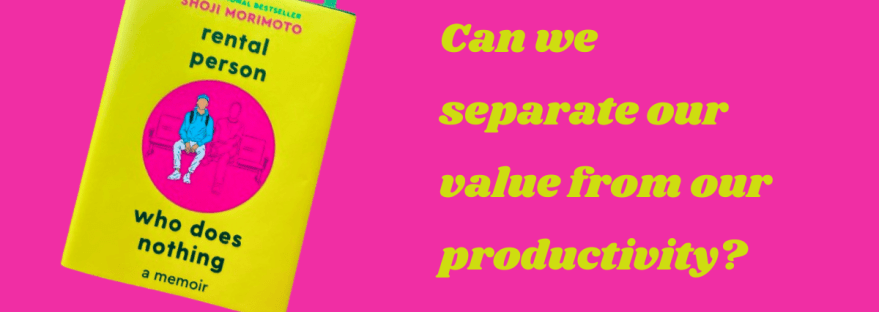
I really like being productive.
This might come as a surprise to those who know me personally. They all know how I sleep deeply in my afternoon naps, often waking up disoriented with bizarre and entertaining dreams. They know how I veg out for hours at a time, streaming shows I’ve already seen before. What I often don’t mention to them is that these indulgences, fun as they are, make me incredibly anxious. I hate myself after I’ve spent all day watching TV, and my 3 pm naps leave me feeling more guilty than rested. The days I am happiest are the days when I knock things off a list. The days I wake up at 6 am, finish working out by nine, get on top of my work, write a few thousand words, cook all my meals…of course, most of the times, these days are a fantasy.
There is a lot I want to do in my life. So much so that I feel paralysed by choice. Should I work on my novel or crank out a new short story? Should I write a blog post, start a newsletter, or maybe, finally get back to Youtube? I want to write an essay, I want to write three, I want to put together an anthology of SFF pieces, I need to publish more, I should write a script, I should be networking, I should be more active on social media, I should read a book, maybe another one, and also that novel I left half-finished on my iPad, or maybe I should draw, maybe I should practice my painting, I should learn how to use Adobe Illustrator, Adobe Photoshop, and also Procreate, I want—I should—I need—I must—
And it’s so overwhelming that, of course, most of the time, I do nothing.

I hesitated before buying this book. I’d spent so much money already, and I didn’t really need it. (Well, that’s not the right metric to use while bookshopping, for, does anyone ever need books? In that traditional sense, no, but, where would we be without them?) Shoji Morimoto’s Rental Person Who Does Nothing seemed, at first glance, unassuming. I wouldn’t have picked this up on my own, it was my friend who brought it to my attention.
This 190-page memoir chronicles the author’s experiences as a “rental person”. He has only one rule for himself: to do nothing. His clients request his presence, either to accompany them to restaurants, Disneyland, or even to file for a divorce. And he goes along with them, nothing more than a presence.
Essentially, pay is given for work. It’s exchanged for something being done. But [health counselor Jinnosuke Kokoroya] argued that people should be paid for just being there—that people have a value even if they do nothing.
Rental Person Who Does Nothing — Shoji Morimoto
[Italics mine]
Essentially, Morimoto argues:
Things can be different simply because someone is there. They don’t have to be there, but if they are, something changes.
Rental Person Who Does Nothing — Shoji Morimoto
His Rental Person experiences speak to that hypothesis. He doesn’t even charge for this service. He lives off his savings and from the tips and gifts he gets from his clients. They only have to pay for his travel expenses.
In the book, Morimoto talks about his dislike for doing things. His dislike for work. He brushes off the criticism that he should suck it up and be an adult. He’s done all that—before he was a Rental Person, he had a very toxic job. As Rental Person, he has been profiled by several media outlets, and his memoir has inspired a TV series. Now, his dream is to continue to do nothing.
I don’t think I could live like that. In fact, in some ways, Morimoto’s life philosophy is so radically different from mine that out of all the books I’ve read, it is this one that challenged my outlook the most. That’s a good thing, in a way. I could never live like he does, but I’m glad he gets to live this way. And I agree with his foundational belief.
I’d like the world to be one where even if people can’t do anything for others, even if they can make no contribution to society, they can live stress-free lives. This is very important to me because of the gap that exists between the value that I sense in people and the value assigned to them by society.
Rental Person Who Does Nothing — Shoji Morimoto
How could I disagree with this? He’s right. The capitalistic society we live in places a premium on productivity. It is the thing that fuels our civilisations. Take cities, for example. Cities are machines of productivity. Our economic system places a price tag on intangibles. How can you price labour? Who decides who gets paid and who doesn’t? Cleaning dishes in a restaurant is a far more physically taxing job than sitting in an air-conditioned glass-panelled office on the 23rd floor of an office building, but one is minimum wage and the other is not. What about the labour of homemakers, usually women, who are expected to slog thanklessly for no pay, no breaks, and little appreciation? What about people who can’t work due to disabilities? Do they have no value at all?
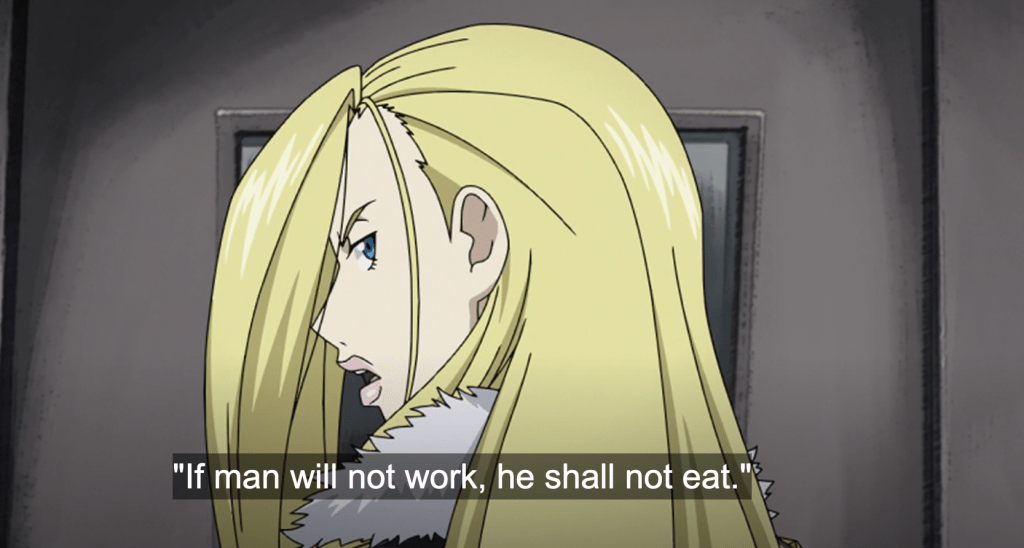
This is General Olivier Mira Armstrong, from Fullmetal Alchemist: Brotherhood. She’s one of my favourite characters from one of my favourite shows, but I don’t like her for her opinions. She’s a good character: fearless, imposing, willing to do anything for her country. She’s necessary for the plot. But if I knew someone like this in person I would hate them. When I first heard this line in the show, I was repulsed by it.
It is dangerous to believe in something so extreme. “If a man will not work, he shall not eat.” It’s a bold statement because at any given time, we may lose our ability to work. On a personal note, my writing productivity has plummeted because of an injury to my hand that makes typing for long stretches very painful. Does this mean I do not have the right to eat?
It makes me question what the definition of work even is. As I type this blog post, I consider myself to be working. I am working when I make dinner, or even lay down to rest. Sleep is essential to be able to work, right?
And ultimately it shouldn’t even matter if something counts as work or not. It doesn’t change the inherent value of a human life. (Actually, this is what FMAB deals with—questions like “what is the worth of a human life?”)
In the book, Morimoto acknowledges that he probably can’t live as Rental Person forever. He has a family. Things may change. But I find his outlook on life strangely optimistic.
Rental Person has been described as “a new-age gigolo” and “a new-age beggar.” I think being a gigolo or beggar are potential ways of relating to people, and the word “new” sounds good, so I feel quite positive about these comments.
Rental Person Who Does Nothing — Shoji Morimoto
For me, the need to be productive will probably never go away. I wouldn’t want it to. I only hope that I become better at containing that anxious energy. I want to do many, many things. I really just need to sit and do them. If I didn’t, I would feel like a failure. Laziness, which is often an affliction for me, is also a source of panic. Doing nothing is my worst fear.
I can’t wrap this blog post up in any enlightening musings. The book was an interesting read, and challenged some of my fundamental beliefs. I will leave you two parting quotes.
A baby is cute when it smiles, of course, and it’s still cute when it’s angry or bawling its head off. It’s cute whether it’s doing something or doing nothing. It’s not trying to be cute, it’s just acting naturally, doing what it wants. Wouldn’t it be wonderful if the world worked like that, so it’s not just me, but everybody could live just as they liked.
Rental Person Who Does Nothing — Shoji Morimoto
You keep asking why your work is not enough, and I don’t know how to answer that, because it is enough to just exist in this world and marvel at it. You don’t need to justify that, or earn it. You are allowed to just live.
A Psalm for the Wild-Built — Becky Chambers

 Damini Kane